
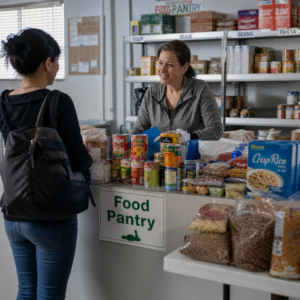
Your first visit to a food pantry may feel uncertain. You might wonder what to bring, whether you qualify, or what people will think. Those questions are understandable. Asking for food when your household needs it is a practical act of care.
You do not have to explain your whole life to this article or prove that you have tried hard enough. The goal is to help you prepare, ask useful questions, and find food you can actually use. Each pantry has its own procedures, so confirm details locally.
Find a nearby place before arranging the trip
Start with Feeding America’s food bank finder. A regional food bank can help you locate local distribution sites. You can also contact 211 in the United States for information about nearby resources.
Check the pantry’s own website or call directly when possible. A map listing may show an office rather than a grocery pickup location, and distribution hours can differ from office hours. Confirm the exact place and date before spending money on transportation.
Ask a few questions ahead of time
You can say, “This would be my first visit. What do I need to know?” If it helps, write your questions down before calling:
- What days and hours do you distribute food?
- Do I need an appointment or advance registration?
- Are there residence, income, or other eligibility rules?
- What paperwork, if any, should I bring?
- Can I collect food without a car?
- How much food should I expect to carry?
You do not need polished words. A short conversation can prevent a wasted trip. If you cannot get through, ask the regional food bank whether it has current information or another nearby option.
Do not assume every pantry asks for the same documents
Some programs request identification, proof of address, household information, or an eligibility statement. Others have different requirements. Ask the specific pantry instead of relying on someone else’s visit in another town.
If you do not have an ID or a permanent address, say so when you call. Ask what alternatives the program accepts and whether another service can help. Do not decide you cannot receive food before finding out the actual rules.
For example, Share Food Program describes its own pantry procedures, including access without an ID. That is one provider’s policy, not a promise that all pantries operate the same way.
Plan for the practical part of collecting food
If you have them, bring sturdy bags, a cart, or a box that is easy for you to carry. Ask whether bags are provided if you have none. Consider how much you can manage on a bus or while walking, especially if you have pain or mobility limitations.
If you cannot stand in a line or lift a box, ask about accommodations before arriving. If the site distributes food through a drive-through, ask whether there is a walk-up option. Availability varies, but naming a barrier gives staff a chance to suggest a workable route.
Tell the pantry about your food needs
Mention allergies, dietary restrictions, and foods you cannot prepare. You can say, “I do not have a refrigerator,” “I only have a microwave,” or “I need food that is easy to chew.” Staff may have limited choices, but these details help them understand what is useful.
Some sites offer prepacked boxes. Others allow you to select from available groceries. Ask which system the site uses. If an item will not work for you, politely ask whether there is an alternative. You can express a need without criticizing someone’s effort.
Give yourself room for a first visit
Follow the site’s instructions for arrival and check-in. There may be a form, a conversation, or a wait. Bring water for yourself if you can, and allow extra time when possible. Ask a volunteer where to begin rather than worrying about getting everything right.
If you feel embarrassed, focus on the task: getting food home. You can bring a trusted person if the site allows it. You do not have to perform gratitude or share personal details with other visitors. A simple thank-you is enough.
Look over the food when you get home
Separate food needing refrigeration from shelf-stable items and plan what to use first. Read preparation and storage instructions. If a package is damaged or you are unsure about an item, ask the pantry or consult reliable food safety guidance rather than guessing.
Our free meal planner can help you turn available food into a short list of meals. For limited equipment, read Meals Without a Full Kitchen. Your plan should fit your home, not an imaginary kitchen.
Ask what happens next
Before leaving, ask when you may return and whether the site knows about other food programs. Do not assume a pantry can supply everything or that every program has the same visit schedule. If one place cannot help, request another referral.
Explore our food assistance guide for additional paths. Food support is there to meet a real need. Today, taking one step toward enough to eat is something worth doing.