
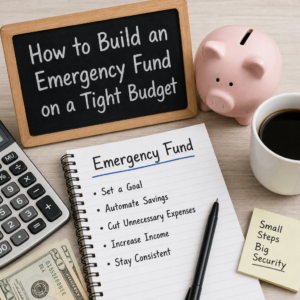
No extra money? Good news, class: you do not need extra money to start an emergency fund. You need $5, a separate place to put it, and Professor Ima’s four-step savings ladder. Let’s build your cushion one small rung at a time.
Why Tiny Amounts Really Do Add Up
Welcome, students! Most advice says to save three to six months of expenses. On a tight budget, that number can feel so big that it is easier to save nothing at all. So let’s skip the giant goal for now and look at what small, steady amounts become in one year:
| You save | After 3 months | After 6 months | After 1 year |
|---|---|---|---|
| $5 a week | $65 | $130 | $260 |
| $10 a week | $130 | $260 | $520 |
| $20 a week | $260 | $520 | $1,040 |
| $1 a day | $90 | $180 | $365 |
That $260 may not sound like much, but it is a new car battery, an urgent care copay, or a late rent fee you never have to pay. Small emergencies are the most common kind, and a small fund handles them beautifully.
Professor Ima’s 4-Step Savings Ladder
Climb one rung at a time. Celebrate each one. Nobody gets a gold star for skipping straight to the top and giving up halfway.
- Rung 1: $100. Your “flat tire and a pizza” fund. It covers the small surprises that usually go on a credit card.
- Rung 2: $500. Enough for most car repairs, a vet visit, or a broken appliance.
- Rung 3: $1,000. A true cushion. Many people sleep better at this rung alone.
- Rung 4: One month of bare-bones bills. Add up rent, utilities, food, phone, insurance and transportation. That total is your next goal. After that, keep growing toward three months.
Where to Find Your First $100
Your first rung is the hardest, so let’s find money that is already sitting around, without cutting anything you love.
- Search for unclaimed money. Old deposits, refunds and forgotten accounts may be waiting in your name. It is free to search. See How to Find Unclaimed Money in Your Name.
- Cash in the coin jar. The average household has more loose change than it thinks. Here is how to save spare change on purpose.
- Sell one thing. The exercise bike holding laundry, the bread maker, the extra stroller. One sale can finish Rung 1 in a weekend.
- Pause one subscription for 3 months. A $15 streaming service paused for three months is $45 for your fund. Free options like Tubi and your library card can fill in.
- Save any “surprise” money. A rebate, a refund, a birthday check, or part of a tax refund goes straight to the fund before it gets spent.
- Lower a bill instead of cutting fun. Ask about utility discounts or a Lifeline phone discount, then save the difference.
Make Saving Automatic (So You Don’t Have to Remember)
- Pay yourself on payday. Set up an automatic transfer for the day your money arrives, even if it is only $5. Money you never see is money you never miss.
- Try round-ups. Many banks offer a free feature that rounds each purchase up to the next dollar and moves the change to savings.
- Make it a game. The 100 envelope challenge and coloring goal trackers turn each deposit into a tiny celebration.
Where to Keep Your Emergency Fund
The best home for emergency money is safe, separate and easy to reach, but not too easy.
- A separate savings account. Keeping it apart from your checking account stops it from slowly melting into groceries. Some people even open it at a different bank so it is out of sight.
- Look for a federally insured account. Accounts at FDIC-insured banks and NCUA-insured credit unions are protected up to $250,000 per depositor, per institution, for each ownership category.
- Avoid monthly fees and minimums. A $5 monthly fee would eat your whole $5 a week. Many online banks and credit unions offer free savings accounts, and some pay higher interest.
- Not in the stock market, and not under the mattress. Emergency money should not go down in value right when you need it, and cash at home can be lost, stolen, or “borrowed.”
Pop Quiz: Is It Really an Emergency?
Professor Ima’s three-question test. If you can answer yes to all three, open the fund with a clear conscience.
- Is it unexpected? Holiday gifts and car registration come every year, so they belong in a sinking fund, not your emergency fund.
- Is it necessary? A broken furnace in January, yes. A half-price sofa, sadly, no.
- Is it urgent? If it can wait a month while you save for it, let it wait.
When You Have to Use It
Using your emergency fund is not failing. It is the fund doing its job. Pay the bill, take a deep breath, and restart your $5 a week. Before you dip in for a big bill, it is also worth asking for help first: hospitals often have free charity care, and many areas offer free food help that frees up money for the emergency.
Having a really tight week right now? Start with My Money Has to Last Until Friday, then come back to Rung 1 when things calm down.
Quick Answers
Should I save or pay off debt first?
Many people build a small starter fund of a few hundred dollars first, so a surprise bill does not go right back on a credit card. Then they put extra money toward debt while still adding a little to savings.
What if I can’t save $5 a week?
Start with $1. The habit matters more than the amount. Saving $1 a day is still $365 in a year.
How do I keep from spending it?
Keep it in a separate account without a debit card, give the account a name like “Do Not Touch,” and track your progress where you can see it. A simple money notebook works wonders.
Professor Cheap’s Wrap-Up
An emergency fund is not built with one big deposit. It is built with $5 on a Tuesday, a sold bread maker, and a jar of quarters. Pick your first rung today, set up that tiny automatic transfer, and you will already be ahead of where you were this morning. Class dismissed, and extra credit for everyone who starts this week!
As an Amazon Associate, Cheap101 earns from qualifying purchases, at no extra cost to you. Browse more handy finds in the Student Store.