
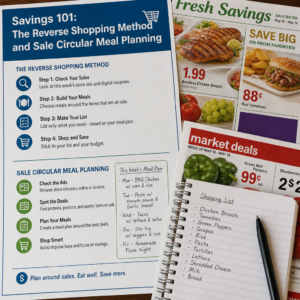
Welcome to the fourth module of your Masters in Savings journey at Cheap101.com. For generations, traditional household budget advisors have repeated the same standard domestic advice: plan your weekly meals in advance, make a detailed grocery list, and stick strictly to that list when visiting the supermarket. While this familiar advice prevents impulse purchases of candy and sodas, it suffers from a fundamental mathematical flaw that quietly inflates grocery bills by hundreds of dollars each month.
Traditional meal planning starts with recipes. You open a cookbook, pick meals you want to eat, write down the required ingredients, and travel to the store to purchase those specific items regardless of their current retail price. If your selected dinner calls for boneless chicken breasts, fresh asparagus, and specialty cheese, you pay whatever the store demands. Today’s lecture introduces a superior paradigm: the reverse shopping method. By flipping this process on its head, you let wholesale discounts dictate your menu, driving your household food costs down by thirty to fifty percent.
1. Understanding the Reverse Shopping Hierarchy
The reverse shopping method transforms the conventional cooking workflow. Instead of moving from recipe to shopping cart, you move in reverse order through three deliberate evaluation stages:
- Stage One (The Pantry and Freezer Audit): You inspect what ingredients you already own before spending a single cent.
- Stage Two (The Circular Clearance Filter): You cross-reference your household gaps against this week’s deeply discounted loss leaders.
- Stage Three (The Menu Assembly): You design your weekly menu strictly using the intersection of your on-hand pantry assets and the advertised sales.
Under this system, you never enter a grocery store with a rigid demand for specific luxury ingredients. You enter the marketplace as an opportunistic buyer, selecting only items that current market conditions have discounted heavily.
2. Conducting the 10-Minute Home Inventory Audit
The most expensive meal you ever prepare is the one made from ingredients that end up tossed into the compost bin a week later. Food waste represents direct financial loss. The foundational step of reverse meal planning begins on Sunday morning with a quick audit of your existing home supply.
Divide your audit into three primary storage areas:
- The Freezer Vault: Check for proteins, frozen vegetables, or leftover stock portions. Identify items that must be consumed soon to avoid freezer burn.
- The Refrigerator Crisper Drawers: Inspect half-used vegetables, open dairy cartons, cheeses, and condiments. These perishables represent your immediate operational priority for the first two dinners of the week.
- The Dry Goods Pantry: Take inventory of bulk foundations like rice, brown lentils, rolled oats, canned crushed tomatoes, pasta shapes, and dried beans. These shelf-stable staples form the backbone of your meal schedule.
By identifying your existing inventory first, your upcoming shopping trip requires only small complementary pieces rather than an entirely new kitchen restock.
3. Structuring Meals Around the Weekly Anchor Protein
In almost every household, protein sources constitute the single largest line item on the grocery receipt. Purchasing meat, seafood, or plant-based protein alternatives at standard full retail will quickly drain your budget. In the reverse shopping method, your weekly dinner rotation is dictated entirely by whatever anchor protein is featured as the store’s primary front-page loss leader.
Consider how this dynamic shapes your weekly meal output:
- Scenario A (Pork Shoulder on Clearance at $1.49/lb): You purchase an eight-pound cut. Two pounds become slow-cooked carnitas bowls with on-hand rice and black beans on Monday. Three pounds become shredded pork sandwiches on Wednesday. The remaining portion is frozen for future weeks.
- Scenario B (Canned Black Beans and Lentils on BOGO Sale): You anchor the week around hearty vegetarian dishes such as slow-simmered lentil soup, black bean quesadillas, and savory grain bowls, keeping your average protein expenditure under seventy-five cents per serving.
- Scenario C (Whole Chickens on Sale for $0.99/lb): You roast the bird on Sunday. Monday utilizes the white meat for wraps. Tuesday simmers the leftover bones with vegetable scraps and pantry noodles to create rich homemade chicken soup.
4. The Rule of Flexible Component Cooking
One of the biggest hurdles beginners face when adopting reverse meal planning is recipe inflexibility. Traditional culinary recipes demand exact items. If red bell peppers are currently priced at three dollars each, following the recipe strictly ruins your cost per plate.
To succeed at level 101 savings, transition from rigid recipes to modular component cooking. A balanced family meal requires four universal components: a complex starch, an anchor protein, a cooked or fresh vegetable, and a flavorful sauce. Treat each component as interchangeable based on store discounts:
- The Vegetable Slot: If broccoli crowns are on sale for ninety-nine cents a pound while green beans are three dollars, substitute broccoli into your stir-fry, pasta, or bake without hesitation.
- The Grain Slot: If brown rice or egg noodles are currently the cheapest staple in your pantry, build your meal base around that grain rather than buying an expensive specialty side dish.
- The Flavor Profile: Stock a basic cabinet of spices, vinegars, and soy sauce. These shelf-stable enhancers allow you to transform the same basic rotation of proteins and vegetables into Italian, Mexican, or Asian inspired dishes without buying single-use marinades.
5. Calculating Cost Per Portion Over Total Cart Cost
The definitive metric of success in the reverse shopping framework is cost per portion. When you inspect a receipt, calculate how many complete, satisfying meals that expenditure yielded for your household.
When you combine on-hand pantry staples, weekly loss-leader proteins, and clearance seasonal vegetables, your average dinner portion cost consistently falls between one dollar and two dollars per person. Over a single calendar year, this single shift in shopping philosophy redirects thousands of dollars from retail registers directly into your personal savings account.
Put this module into practice this week: audit your refrigerator drawers, open your local store circular, and draft your seven-day dinner rotation around what is already on clearance.