
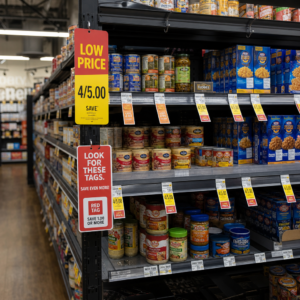
Welcome back to the Cheap101.com classroom for your next module in the Masters in Savings program. When shoppers step inside a modern supermarket, they enter an intentionally engineered retail space designed to maximize checkout totals. From fragrant bakeries placed right at the front doors to eye-level product placements on middle shelves, grocery retailers rely on human psychology to prompt full-price impulse buys. To counter this system, every serious student of frugality must master the foundational commercial mechanic known as the loss leader.
A loss leader is an item priced directly at or below wholesale acquisition cost, marketed specifically to draw shoppers through the doors. Supermarkets willingly forfeit profit on these key staples because retail models prove that average shoppers will purchase thirty other items at standard, high-margin prices. In today’s lecture, we break down how to isolate these doorbusters, track cyclical price drops, and build a personalized price book to secure wholesale-level grocery bills.
1. Decoding the Weekly Circular
Every Wednesday or Thursday, supermarkets release weekly sales circulars in print and through mobile apps. To capture maximum value, treat this circular like a tactical price map rather than promotional reading.
Circulars are divided into three distinct zones:
- The Front Page Doorbusters: The prominent photos on the front page of the weekly ad are almost always true loss leaders. These items typically feature whole chickens, seasonal produce like apples or berries, name-brand butter, or gallon milk priced far below standard retail. The supermarket expects to lose money on these transactions.
- The Inside Pages: As you flip past the front cover, the discount structure changes dramatically. Middle pages highlight minor discounts (such as ten cents off a box of crackers) or bundle promotions (such as buy four frozen entrees to save two dollars). These are store promotions designed to reclaim the margin lost on the cover.
- The Back Cover Anchors: The back page often mirrors the front page with two or three deeply discounted staples, especially pantry goods like canned beans, broth, pasta sauce, or soda twelve-packs.
Your tactical goal during each shopping trip is straightforward: purchase exclusively from the front and back cover zones, while ignoring the high-markup interior pages.
2. The Mechanics of the 12-Week Sale Cycle
Supermarket pricing is rarely random. Major grocery chains operate on predictable rolling inventory rhythms, typically revolving around an eight-to-twelve-week calendar. Understanding this rhythm eliminates any worry about missing a promotional discount.
Consider pantry staples like pasta sauce, peanut butter, or breakfast cereal. When a brand drops to its absolute rock-bottom price point (such as ninety-nine cents per jar), that specific promotion will vanish the following week. However, the store will not keep that item at full price indefinitely. The item will steadily cycle through various promotional tiers before hitting that same rock-bottom price point again in about twelve weeks.
Once you recognize that grocery pricing is seasonal and cyclical, your purchasing behavior fundamentally shifts. Instead of buying one bottle of cooking oil at full price whenever your pantry runs dry, you purchase a twelve-week household supply whenever the cyclical low price arrives. You transition from an emergency consumer into a strategic inventory manager.
3. Constructing Your Foundational Price Book
To identify whether an advertised sale represents a genuine bargain or merely clever marketing, every student in the Masters in Savings curriculum needs a personal price book. A price book is a reference register tracking the baseline unit pricing of your household’s top twenty consumable goods.
Setting up your price book requires three basic steps:
- Track Unit Pricing, Not Package Price: Never compare items by total package cost. Always evaluate the price per ounce, price per pound, or price per sheet. A five-dollar box of detergent might look affordable until you calculate the cost per load against a competing bulk option.
- Document the Standard Retail Ceiling: Record what the item costs on an average day when no promotional discounts apply. This serves as your benchmark for calculating actual percentage savings.
- Establish the Buy-In-Bulk Trigger Price: Identify the lowest price the item reaches during its twelve-week cycle. When the shelf tag matches or beats this target, trigger your bulk purchase protocol and buy enough volume to last until the next expected cycle.
4. The Perimeter-Only Shopping Discipline
The vast majority of genuine loss leaders are concentrated strictly along the physical perimeter of the store: produce, fresh meat counters, dairy cases, and basic bakery racks. The interior aisles, often called center-store dry grocery, carry the highest profit margins for the grocer and the lowest nutritional-to-cost ratio for the consumer.
Adopting a perimeter-first shopping habit aligns your cart with fresh, whole foods while shielding your budget from high-margin packaged convenience items. When you must enter the center aisles for specific dried goods like rice, rolled oats, or beans, look to the top shelf or the absolute bottom rack to find lower-priced store-brand options with identical ingredients.
5. Ethical Cherry-Picking: The Ultimate Frugal Tactic
The term cherry-picking describes entering a retail establishment, purchasing strictly the advertised loss leaders, and walking out without buying high-margin companion items. Retail executives rely on consumer habit or social discomfort to prevent this, hoping you will purchase full-price salad dressing or snacks alongside your discounted chicken.
As a student of Cheap101.com, you must discard the idea that you owe the store a balanced transaction. Supermarkets price their items according to calculated business strategies, and you are entitled to buy exactly what serves your family budget. Combining loss-leader purchases across two neighboring stores allows you to assemble an entire cart composed exclusively of subsidized goods.
Mastering supermarket sales cycles and loss leaders provides the operational baseline for long-term grocery frugality. Review this week’s local circulars, record your core unit prices, and prepare to execute your shopping list with mathematical precision.