
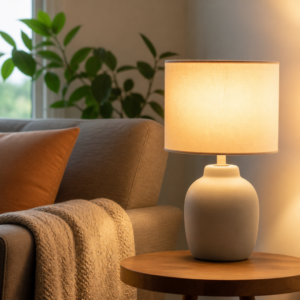
A bright, welcoming home does not have to come with a big electric bill. With a few smart lighting habits and the right bulbs, you can enjoy every cozy lamp you love and keep more money in your pocket each month.
Simple Habits That Trim Your Lighting Costs
Welcome to class! Today’s lesson is one of my favorites because it is so easy to pass. Lighting is a small slice of most home energy bills, but it is a slice you control every single day. A few friendly habits add up quickly.
- Light the task, not the whole room. A reading lamp beside your favorite chair often does the job of three ceiling fixtures.
- Make friends with daylight. Open blinds during the day, keep windows clean, and set up your reading or hobby spot near a sunny window.
- Use lighter colors. Pale walls, a light lampshade, and a mirror placed across from a window bounce light around, so one bulb feels like two.
- Click it off on the way out. A little habit, like turning off the light when you leave a room, is free and pays you back all year.
- Dust your bulbs and shades. A clean bulb and shade let more light through, so you may find a lower brightness is plenty.
Read the Box: Lumens Are the New Watts
With old incandescent bulbs, we shopped by watts. Today the number to watch is lumens, which tells you how much light a bulb gives. Watts tell you how much electricity it uses. As a rough guide, about 800 lumens is similar to the old 60 watt bulb, and about 1,100 lumens is close to the old 75 watt bulb. Many LED boxes also say “60W equivalent” to make shopping easy.
Next, look at color temperature, measured in Kelvin (K). Around 2700K gives a warm, golden glow that feels like a classic lamp, lovely for living rooms and bedrooms. Around 3000K to 3500K is a soft white that suits kitchens and baths. Around 5000K is crisp and cool, handy for a workbench, garage, or craft table.
Try It Free First
Before you buy anything, take a little lighting tour of your home. Which lights are on the longest each day? The porch light, the kitchen ceiling light, and your favorite lamp are usually the big ones. Those are the spots where a more efficient bulb earns its keep fastest. You can also check with your local utility company, since some offer free or discounted bulbs or home energy checkups. It never hurts to ask!
Where LED Light Bulbs Fit In
LED bulbs use much less electricity than old incandescent bulbs to make the same amount of light, and they are rated to last many years. That means fewer trips up the step stool, which is a nice bonus all by itself. They also stay cool to the touch compared to old-style bulbs, and they come in nearly every shape you can think of: standard household bulbs, candle bulbs for chandeliers, globes for vanities, and floodlights for porches.
A smart way to start is to swap the bulbs in your most-used fixtures first, then replace the others one at a time as old bulbs burn out. Multi-packs often bring the price per bulb down, so it can pay to buy a set that matches the fixtures you use most.
What to Look For When Comparing
- Lumens and “watt equivalent”: match the brightness you are used to.
- Color temperature: warm white for cozy rooms, daylight for work spaces.
- Base and shape: check your fixture (standard, candelabra, or flood) before ordering.
- Dimmable or not: if your switch is a dimmer, choose bulbs labeled dimmable.
- Enclosed fixture rating: for covered ceiling lights, look for bulbs rated for enclosed fixtures.
- Pack size, reviews, and return terms: compare listings to find good value.
Professor Ima’s Wrap-Up
A well-lit home is a happy home, and it can be a thrifty one too. Use daylight, light only what you need, and swap your busiest bulbs for efficient ones. That is an easy A, and your electric bill will be your proudest report card. Class dismissed, and keep shining!
As an Amazon Associate, Cheap101 earns from qualifying purchases, at no extra cost to you. Browse more handy finds in the Student Store.