
A new walker can cost more than a week of groceries. A wheelchair or hospital bed can cost far more. Here’s the good news from the Financial Aid Office: much of this equipment is available free or nearly free, if you know where to ask. Today’s lesson covers the best places to look, starting with the cheapest.
Lesson 1: Borrow It Free From a Loan Closet
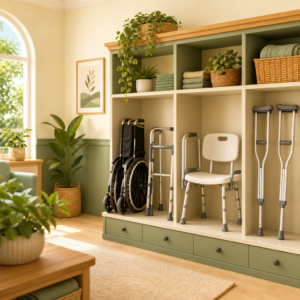
A medical equipment loan closet is a program that collects donated equipment, cleans it, and lends it to people who need it, usually at no cost. Many are run by churches, senior centers, Lions Clubs, Rotary Clubs, fire departments, and county aging offices.
Common items include:
- Wheelchairs and transport chairs
- Walkers, rollators, canes, and crutches
- Shower chairs, tub benches, and raised toilet seats
- Bedside commodes
- Knee scooters
- Sometimes hospital beds and lift chairs
How to find one near you:
- Search online for “medical equipment loan closet” plus your town or county.
- Call your local senior center or Area Agency on Aging. The free Eldercare Locator at 1-800-677-1116 can connect you.
- Ask at your church, synagogue, or community center. Many keep a closet even if they don’t advertise it.
- Ask your doctor’s office, hospital discharge planner, or a home health nurse. They usually know the local options.
Professor’s tip: Some loan closets ask for a short form signed by your doctor, and some only serve residents of one county. Call ahead so you don’t make the trip for nothing.
Lesson 2: Check Your State’s Assistive Technology Program
Every state has a free Assistive Technology (AT) program, funded through the federal Assistive Technology Act. Many of them run device reuse programs that pass along gently used equipment at little or no cost, and many also let you borrow a device to try before you buy, which can save you from paying for the wrong thing.
To find yours, visit the AT3 Center’s state program directory and choose your state.
Lesson 3: Let Medicare or Medicaid Pay
If you have Medicare, Part B covers medically necessary durable medical equipment (like wheelchairs, walkers, canes, crutches, hospital beds, and oxygen equipment) when your doctor prescribes it for use in your home.
What it costs you: After you meet the Part B deductible, you pay 20% of the Medicare-approved amount, as long as the supplier accepts assignment. A Medigap (Medicare Supplement) plan may cover some or all of that 20%.
Professor’s homework before you order:
- Get a prescription from your doctor.
- Use a supplier enrolled in Medicare, and ask whether they accept assignment. If they don’t, you can be charged more.
- If you’re renting, make sure the supplier accepts assignment for every rental month.
- If you have a Medicare Advantage plan, call your plan first. You may need to use specific suppliers.
Details are on Medicare’s equipment coverage page.
If you have Medicaid, it also covers many kinds of medical equipment with little or no cost to you. Rules vary by state, so ask your doctor or call your state Medicaid office.
Veterans: If you’re enrolled in VA health care, the VA may provide equipment through its prosthetics and sensory aids service. Ask your VA care team.
Lesson 4: Look for Condition-Specific Programs
Some national groups lend or help pay for equipment for people with specific conditions. For example, the ALS Association runs equipment loan programs through its care services coordinators. If you or a loved one has a particular diagnosis, ask the national organization for that condition, or your local chapter, about equipment help.
Lesson 5: Buy Used, Smartly
If you need to buy, gently used equipment can cost a fraction of new:
- Facebook Marketplace, Craigslist, and Nextdoor (many families give equipment away free after a loved one recovers or passes)
- Thrift stores and resale shops, including Habitat for Humanity ReStores in some areas
- Local “Buy Nothing” groups
- Your state AT program’s online equipment exchange, if it has one
Safety check before you buy used: Test brakes, wheels, and locks. Check for cracks, rust, and wobbly legs. Make sure the weight limit is right for the person using it. For anything that lifts, supports a lot of weight, or needs to fit a specific body, like a power wheelchair or patient lift, it’s worth getting advice from a doctor or therapist first.
Lesson 6: Pay It Forward
When you’re done with your equipment, pass it on. Donate it back to a loan closet, give it to your state’s reuse program, or offer it free in a local group. Someone else’s wallet, and their recovery, will thank you.
Quick Review: Where to Look, Cheapest First
- Local loan closet (free)
- State Assistive Technology program reuse or loan (free or low cost)
- Medicare, Medicaid, or VA (covered with a prescription)
- Condition-specific charity programs (free or reduced cost)
- Used equipment from neighbors and resale shops (a fraction of retail)
Want more ways to cut medical costs? See How to Save Money on Healthcare Costs and Healthy Wallet, Healthy You. Paying too much at the pharmacy? See 10 Ways to Save Money on Prescriptions, and find out if you qualify for a Lifeline discount on your phone or internet bill.
Need More Than Savings?
If medical bills, prescriptions, or other costs are stacking up, our sister site Chances.org has free, step-by-step guides to help:
- Health Care Help: free and low-cost care, help with medical bills and prescriptions
- Government Benefits: programs you may qualify for
- How to Care for an Aging Parent: where to start and where to find help
- Free Printable Medication List: keep track of every medicine for appointments
Class dismissed. Now go borrow that walker for free.