
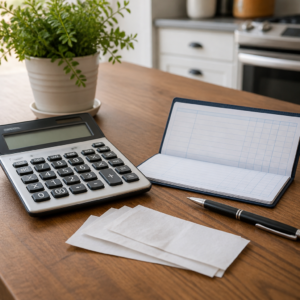
Balancing a checkbook or adding up a grocery cart gets so much easier when the numbers are big and bold. A few simple math habits, plus a calculator you can read at a glance, can keep your money crystal clear and your budget right on track.
Simple Math Habits That Keep Money Clear
Good morning, class! You do not need to be a math whiz to be a money whiz. A handful of easy routines will keep your checkbook balanced and your grocery total happily within budget.
Balancing your checkbook
- Record as you go. Write each check, debit, and deposit in your register the same day.
- Keep a running balance. After every entry, add or subtract so you always know where you stand.
- Match your statement monthly. Check off each item that appears on your bank statement, then add up anything still outstanding.
- Do it twice. Run the numbers once forward and once again to confirm. A quick double check catches little slips.
- Circle the fees. Bank fees and automatic payments are easy to miss, so mark them clearly.
Grocery store math
Adding as you shop is a wonderful way to arrive at the register with no surprises. Round each item up to the nearest dollar and keep a running total. Rounding up gives you a small cushion, so the real total usually comes in a little lower. That is a pleasant feeling!
Unit prices are your best friend. Divide the price by the number of ounces, pounds, or count to see the true cost per unit. A big box is not always the better deal, and a quick division tells you for sure. Many shelf tags show unit prices too, but they sometimes use different units for similar items, so doing your own math keeps things fair.
Handy everyday calculations
- Percent off: multiply the price by the discount (0.25 for 25 percent) and subtract.
- Tips: find 10 percent by moving the decimal one place left, then double it for 20 percent.
- Monthly to yearly: multiply a monthly bill by 12 to see its full yearly cost.
Try It Free First
Your phone almost certainly has a calculator built in, and many phones let you turn it sideways for more features. You can also enlarge text in your phone’s settings for easier reading. Paper and pencil work beautifully too, and jotting numbers down leaves a record you can review later.
Where a Large-Display Calculator Fits In
A large-display desktop calculator shows big, high-contrast numbers and usually has roomy buttons that are easy to press. It lives on the desk right next to your checkbook and bills, always ready, with no unlocking or app searching. Many run on solar power with a battery backup.
It can suit anyone who prefers reading numbers comfortably at a glance, folks who do their monthly bills at the kitchen table, and households that like keeping money tasks off the phone. A pocket size version can tag along to the store as well.
What to Look For When Comparing
- Screen size and digits: 10 or 12 digits handles most household math.
- Button size and feel: large keys with clear labels are easier to use.
- Power: solar plus battery keeps it working in any light.
- Tilted display: an angled screen is easier to see from your chair.
- Extra keys: percent and memory keys are handy for budgets.
- Reviews and returns: compare reviews and check the return terms.
Professor Cheap’s Wrap-Up
Money math is mostly adding, subtracting, and a little rounding with a smile. Whether you use your phone, a pencil, or a big friendly calculator, the habit is what makes your budget shine. Now go forth and add up those savings, my bright students!
As an Amazon Associate, Cheap101 earns from qualifying purchases, at no extra cost to you. Browse more handy finds in the Student Store.