
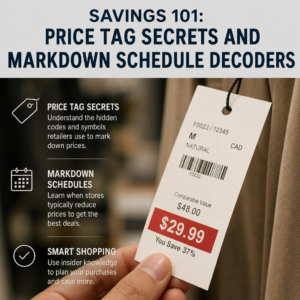
Welcome to the fifth lecture of your Masters in Savings curriculum at Cheap101.com. When you browse the aisles of major national department stores, big-box chains, and wholesale clubs, every shelf tag tells a detailed story. Most shoppers glance only at the large bold price number, completely ignoring subtle clues printed in the margins. To retail inventory managers, price tags are operational instruments that convey markdown stages, liquidation urgency, and product lifecycles. Once you learn how to read these hidden signals, you gain the power to predict future discounts and buy goods at their lowest possible price point.
Every major retail chain relies on internal tag encoding systems to direct floor workers on stock disposition. Knowing whether an item has hit its terminal clearance floor or is scheduled for another round of markdowns next Tuesday separates casual shoppers from true savings specialists. In today’s module, we decode the clearance price tag algorithms for prominent national retailers, outline standard weekly markdown schedules, and teach you how to time every purchase with precision.
1. Decoding the Big-Box Giants: Target, Walmart, and Home Depot
Big-box retailers handle massive inventory volumes, which requires automated, rules-based markdown schedules. Understanding their tag ending rules prevents you from buying too early or waiting too long on limited inventory.
The Target Tag Algorithm: Target clearance tags carry small, precise numbers that indicate discount velocity.
- Price Endings of .99: This reflects regular retail price. Avoid buying non-essential discretionary items at this tier.
- Price Endings of .98, .04, or .08: These numbers indicate an active clearance markdown. Look in the extreme upper-right corner of the small red clearance sticker. You will see a tiny two-digit number, typically 15, 30, 50, 70, or 90. That number reveals the exact percentage discount off original retail.
- Terminal Floor (.04): When an item reaches a price ending in .04, it has hit its final clearance round. Target rarely discounts items further before pulling them from the sales floor for salvage donation.
The Walmart Terminal Pricing Code: Walmart employs a straightforward three-tier clearance progression:
- Ending in .97: Regular everyday low price.
- Ending in .00 or .50: Store manager special markdowns. These occur when an individual store manager needs to liquidate localized surplus inventory quickly.
- Ending in .01 or .05: Final liquidation pricing. When a Walmart item drops to a price ending in .01 or .05, the corporate system has slated the inventory for immediate removal. Grab these items immediately, as restocks will not occur.
The Home Depot Tag Colors and Endings: Home Depot utilizes yellow tags for clearance merchandise:
- Yellow Tag Ending in .06: The item was marked down six weeks ago and will drop further in roughly three to four weeks.
- Yellow Tag Ending in .03: The item has reached its terminal clearance tier. If stock remains after three weeks at this price point, employees remove the stock from shelves entirely.
2. Cracking Wholesale Club Codes: Costco and Sam’s Club
Wholesale clubs operate on razor-thin operating margins, making their markdown signals especially valuable for bulk household purchasers.
The Costco Asterisk and Cent Rules: The famous Costco price tag system is one of the most reliable discount indicators in retail:
- Ending in .99: Standard manufacturer price with regular club markup.
- Ending in .97: A manager clearance markdown. These prices are manually set by the store manager to clear seasonal stock, discontinued consumer electronics, or overstocked dry goods.
- Ending in .00 or .79: Manufacturer-supported clearance. These price points typically signify special promotional credits from the brand.
- The Upper-Right Asterisk (*): The presence of an asterisk in the top right corner of the shelf sign is the critical signal. Known by warehouse shoppers as the star of death, it indicates that the item is discontinued. When an asterisk appears alongside a price ending in .97, the item is at its lowest possible price.
Sam’s Club Letter Designations: Sam’s Club prints small capital letters alongside the price tag to indicate inventory status:
- Letter A (Active): Standard regular inventory that will be replenished regularly.
- Letter C (Canceled): Discontinued by corporate merchandising. No further shipments will arrive.
- Letter O (One-Time Buy): A limited seasonal inventory run that will not return once sold out.
3. Mapping Weekly Departmental Markdown Schedules
In addition to tag endings, retailers follow strict departmental markdown calendars. Store teams work through designated departments on specific days of the week.
National retail workflows generally follow this weekly pattern:
- Mondays: Electronics, children’s apparel, infant accessories, books, and stationery.
- Tuesdays: Women’s apparel, groceries, pet supplies, and home decor clearance.
- Wednesdays: Men’s apparel, lawn and garden items, furniture, and health and beauty goods.
- Thursdays: Housewares, athletic gear, shoes, luggage, and sporting equipment.
- Fridays: Cosmetics, jewelry, hardware, and automotive supplies.
Timing your visits to align with specific departmental markdown days guarantees that you encounter the freshest markdowns before rival bargain hunters clear the shelves.
4. The Wait or Buy Decision Matrix
One of the greatest hazards in clearance shopping is holding out for a deeper discount only to watch remaining inventory disappear completely. Apply this practical decision rule:
- Shelf Quantity Count: If there are more than ten units of an item on the shelf, you can comfortably wait for the next price reduction tier.
- Single Unit Warning: If fewer than three units remain, purchase immediately if you have an active need for the item. The risk of missing the item entirely outweighs the minor potential savings of waiting another week.
- Check Neighboring Top Racks: Floor workers frequently place overstock on high riser shelves directly above clearance endcaps. Always look upward to evaluate true back-stock quantity before deciding whether to wait.
Cracking the code on retail price tags turns shopping trips into strategic operations. Pay close attention to ending numbers on your next outing, verify the percentage markers, and let retail algorithms work to your financial benefit.