
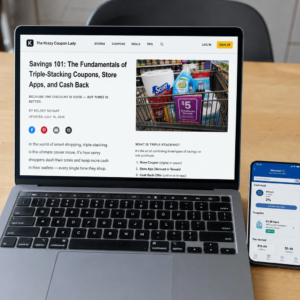
Welcome to Savings 101, your foundational coursework in the Masters in Savings program at Cheap101.com. If you have ever watched seasoned bargain hunters walk out of a supermarket or pharmacy paying pennies on the dollar for household essentials, you might assume they were relying on extreme paper binders, complicated fine print, or questionable loopholes. In reality, modern budget mastery relies on a systematic, repeatable mathematical technique known as triple-stacking.
Triple-stacking is the disciplined practice of layering three distinct discount tiers on top of a single retail transaction: a store promotion, a manufacturer discount, and a third-party rebate. When executed correctly, this approach strips away retail margins and drives product costs down by 50% to 90%. Today’s lecture provides the complete theoretical framework and practical execution steps required to master coupon stacking.
Layer 1: The Store Promotion and Base Markdown
The bottom layer of every successful stack begins with the retailer’s own pricing structure. Never apply valuable coupons or rebates to full-price retail merchandise. Doing so yields modest savings on inflated numbers. Instead, your foundation must always be an active sale, a promotional buy-one-get-one (BOGO) event, or an advertised clearance markdown.
Retailers like Target, Walgreens, and regional grocery chains publish weekly circulars designed to drive foot traffic. Common Layer 1 promotions include:
- Direct Sale Pricing: Temporary price drops (such as brand-name laundry detergent marked down from $12.99 to $8.99).
- Store-Wide Threshold Offers: Promotions such as “Spend $25 on household paper products, receive a $5 store gift card” or “Buy 2 select personal care items, earn $4 in store rewards.”
- In-App Store Offers: Retailer-funded digital circle offers, store-brand discounts, or loyalty specials that reduce the shelf price before external discounts are introduced.
By starting with a reduced base price, every subsequent discount percentage cuts exponentially deeper into the true out-of-pocket cost.
Layer 2: Manufacturer Coupons (Paper or Digital)
Once your foundational store sale is identified, Layer 2 involves introducing a manufacturer coupon. A manufacturer discount is subsidized directly by the brand (such as Procter & Gamble, Unilever, or General Mills), not the store selling the item. Because the store gets reimbursed by the manufacturer for the face value of this coupon, retail policies allow you to combine one manufacturer coupon with store promotions.
In modern retail environments, Layer 2 discounts exist in two primary formats:
- Digital Account Clips: Found directly within your store’s loyalty app (such as Target Circle, CVS ExtraCare, or myWalgreens). You simply tap to clip the digital manufacturer coupon to your barcode or registered phone number.
- Traditional Print and Insert Coupons: Clipped from Sunday newspaper inserts (Save, SmartSource) or printed directly from certified brand websites.
The Golden Rule of Layer 2: Retail checkout registers will generally accept exactly one manufacturer coupon per physical item scanned. If you purchase two identical boxes of cereal under a BOGO promotion, you can legally and ethically apply two individual manufacturer coupons (one for each item in your basket) unless the coupon terms specifically stipulate otherwise.
Layer 3: Post-Purchase Rebate and Cash Back Apps
The third layer of the stack is where modern frugal shoppers gain a decisive edge over traditional couponers. Layer 3 occurs outside the store’s point-of-sale register, which means it bypasses cashier discretion, scanning delays, and register coupon caps entirely.
After completing your purchase and receiving your receipt, you submit that receipt to third-party cash back rebate apps:
- Item-Specific Rebate Apps: Platforms like Ibotta allow you to unlock rebates on specific grocery and household brands (such as $2.00 cash back on a specific tube of toothpaste or $1.50 back on brand-name coffee).
- Receipt Capture Platforms: Apps like Fetch Rewards award points on every uploaded receipt, with significant point bonuses attached to participating consumer goods.
- Payment and Browser Portals: If shopping online for in-store pickup, initiating your shopping session through cash back platforms like Rakuten or TopCashback provides an additional 2% to 10% refund on the subtotal.
- Category Cash Back Payment Cards: Paying with a credit card that offers 3% to 6% cash back on grocery purchases adds an automatic micro-discount across the entire bottom line.
A Practical Field Study: Building the Triple Stack
To understand how these three tiers work in unison, observe this practical household goods scenario:
- The Item: A premier brand shampoo retails at a standard price of $8.49.
- Layer 1 (Store Promotion): The pharmacy runs a weekly sale dropping the shelf price to $6.00, plus an in-store reward offer: “Buy 2, earn a $4 store register reward.” You place two bottles in your cart for an initial subtotal of $12.00.
- Layer 2 (Manufacturer Coupon): You clip a digital manufacturer coupon in the store app for $3.00 off two bottles. At checkout, the register automatically deducts $3.00. You pay $9.00 out of pocket and receive your $4.00 store register reward for future use (effective cost: $5.00 for both bottles).
- Layer 3 (Rebate Stack): You scan your physical receipt into Ibotta, which is running a $1.50 cash rebate per bottle ($3.00 total refund).
- The Final Bottom Line: After receiving your $3.00 cash rebate, your true net cost for both bottles drops to just $2.00, or $1.00 per bottle. This represents an 88% overall discount from original retail.
Critical Rules and Best Practices
As you begin practicing coupon stacking, adhere strictly to these core parameters:
- Never Buy Items You Do Not Need: A 90% discount on an item your household will never consume is a waste of financial resources. Build stacks exclusively around items you routinely use.
- Track App Reset Windows: Rebate app offers often expire or reset within 24 to 48 hours after being claimed. Verify that your desired rebate is active in the app immediately before paying at the register.
- Maintain a Clear Paper Trail: Always request a printed receipt at checkout. Digital e-receipts are occasionally delayed by receipt-scanning apps, whereas crisp paper slips scan smoothly.
Mastering the fundamentals of triple-stacking transforms everyday grocery and personal care shopping from an unpredictable monthly expense into a structured, highly predictable saving routine.